A broadly-neutralizing antibody against Orthoebolavirus glycoprotein that potentiates the breadth and neutralization of other antibodies
We’re delighted to share that Fran’s doctoral work on monoclonal antibodies against Ebola has been published in npj Viruses.
The deadly Ebolavirus Disease (EVD) is caused by several species of the Orthoebolavirus family. The only currently approved treatments for EVD are monoclonal antibodies (mAbs) that bind to the virus Glycoprotein (GP) on its surface. However, these mAbs are only approved for treatment of EVD caused by one species of the virus, Orthoebolavirus zairense (Ebola virus, EBOV). Therefore, mAbs targeting multiple Orthoebolavirus species may represent the next generation of EVD therapeutics.
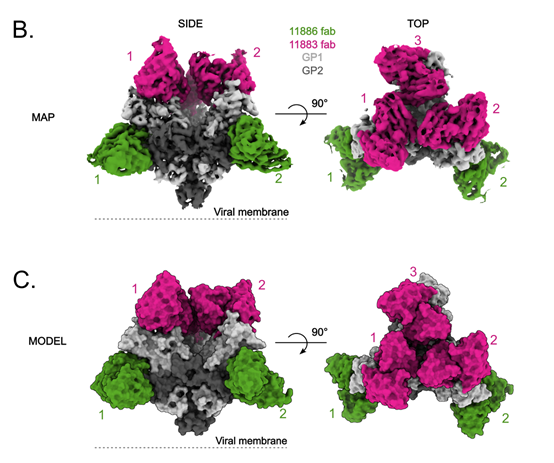
In this study, broadly reactive anti-GP mAbs were produced; these mAbs could bind to GP from all species of the Orthoebolavirus family. Among these, mAbs 11886 and 11883 were broadly neutralizing in vitro, meaning that they could prevent multiple species of the virus from infecting cells. A 3.0 Å cryo-electron microscopy structure of EBOV GP bound to both mAbs shows that 11886 binds a novel epitope bridging the glycan cap (GC), 310 pocket and GP2 N-terminus of the GP, whereas 11883 binds the receptor binding region (RBR) and GC. In vitro, 11886 synergized with a range of mAbs with epitope specificities spanning the RBR/GC, including 11883. Notably, 11886 increased the breadth of neutralization by partner mAbs against different Orthoebolavirus species. These data provide a strategic route to design improved mAb-based next-generation EVD therapeutics.
This work was completed in collaboration with labs at UCB, the Marburg Institute for Virology , School of Veterinary Medicine University of Wisconsin-Madison, and with the Saphire Lab at the La Jolla Institute for Immunology.